| JNTU Kakinada |
| The College was established on 16th July 1946 as the College of Engineering, Visakhapatnam situated at Kakinada. It was later named as the Government College of Engineering, Kakinada. After being initially affiliated to the University of Madras and later to the Andhra University, it became a constituent College of the Jawaharlal Nehru Technological University at the time of its formation on 2nd October 1972. |
 |
JNTU - Kakinada |
| The Campus is spread over a sprawling area of about 110 acres. The college provides hostel accommodation for about 250 boys and 250 girls. Other amenities on the campus include Bank, Post-Office, dispensary, guesthouse, and play fields. College has a good library with about 40,000 volumes. The college also subscribes to a good number of national and international journals. read more.. |
| Kakinada Deep Water Port |
 |
In the case of Kakinada Port, we can find easily that its potential from the view-point of cargo generation capacity of its hinter-land is being under-utilised. The level of infrastructure available at the port is found to be far short of the requirements for handling export/import cargoes belonging to the industries that have come up or are proposed to be set-up in the port's hinter-land. |
| Kakinada Deep Water Port |
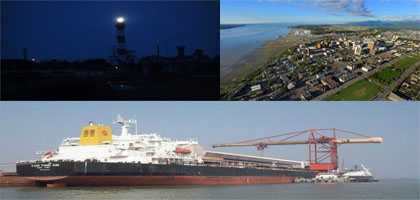
| Hence, for meeting the requirements of handling liquid cargoes like GFCL raw materials, POL or Hindusthan Petroleum Ltd., Etc., and for meeting the future requirements of growth and modernisation, the Deep Water Port facility is created with 150 crore ADB financial assistance.It has 3 Berths of length 610 M. and commissioned from October 1996. Under privatization policy the same is now manned by Kakinada Sea Port Private Limited from 1st April 1999 onwards. |
| Kakinada Port |
| The Port of Kakinada is on the Southern Part of East Coast of India at 16.56' (North) & Longitude 82.15'.(East). It is the principal sea port amongst the minor ports in INDIA and is under the control of the government of the State of Andhra Pradesh. The maritime history of the Port dates as far back as the year 1805, when the port of "Coringa" nearby had to be closed due to shoalir.g. The port activities for handling sailing ships of those days took place near about the present Jagannaickpur Bridge. In order to prevent silting in the navigational channel groynes were built extending them from time to time towards the sea, to a length of about 5 Kms. Thus the present commercial canal with a length of about 5 Kms. and width of about 70 Mts. had been formed for maintaining depths for boat navigation. |
 |
| Kakinada Port |
| This port is classified as an intermediate port and is all weather sheltered anchorage port. Kakinada Bay, with water spread of about 2.5 Sq.Km. is encircled and protected upto three quarters of its perimeter by the mainland and the Godavari sand spit, also known as "Hope Island". This Island had originated about 200 years ago from the mouth of the river littoral drift along the shoreline and had extended to a length about 11 nautical miles so far, thus forming into a natural breakwater protecting the entire eastern portion from the fury of the sea and providing tranquility and shelter to the ships which are berthed at anchor in the Kakinada Bay. Thus, the port of Kakinada has become one of the safest natural harbours on the east coast of India. |
| Communications : Kakinada Port |
 |
The district is served by Rail line (Broad guage) double line from Rajahmundry to Tuni and single line from Kakinada to Samalkota covering a distance of 126 km only. Hence people have to depend upon Road Transport.Almost all the places in the district are connected by well-laid out roads. With the construction of the bridges across River Godavari at Alamuru, Yedurulanka, Chinchinada and Siddantham and Rail-cum-Road bridge at Rajahmundry connecting East |
| Kakinada Port |
| and West Godavari Districts the movements of passengers and Transport of Goods to the several parts of the state had become easy. The District has a network of navigation canals also facilitate transport by boat. Mostly Agricultural commodities like Coconut and other goods are carried through water transport system. |
| Kakinada Anchorage Port |
| Kakinada Port is situated in the East Coast of India in Latitude 16o56' N Longitude 82o15'E. This is an all weather Lighterage Port developed in a naturally sheltered bay called as Godavari Sand Spit. It affords excellent protection to the water spread of the bay measuring about 100 Sq.Km. and renders complete protection to the Port of Kakinada from South - West Monsoon. Cargo is transported through privately owned Steel barges from ship to shore and vice versa through the commercial canal. |
 |
| Kakinada Anchorage Port |
| Realising the Extraordinary potential for growth of traffic through the port of Kakinada, which could not be exploited due to lack of adequate Port facilities. The Government of Andhra Pradesh (GOAP) in G.O.Ms.No.74, public works (B1) Department, Date.20-1-1977 constituted a technical committee. read more.... |