|
| |
|
 |
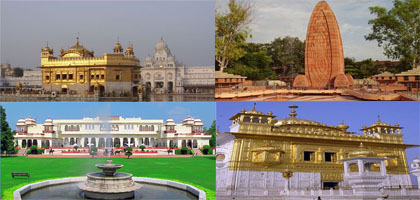
Long ago, the present city of Amritsar was dense forest with a pool in it. Several villages fringed the forest. Many legendary and mythological references are attached to this land. It is said that Lord Rama had fought a battle with his sons, Luv and Kush at this place in which whole of Lord Rama's army was destroyed. At that time a jug of nectar descended from heaven to restore the soldiers to life.Amritsar is one of Punjab´s principal cities, dating back in history over 400 years. It is known more for the world famous Golden Temple, the seat of Sikh religion.Situated on the north-western border of India, the city is also gateway for the travelers on the overland route through Pakistan. The Wagah border, which is the check-post is about 29 kms away. Amritsar literally means "the pool of nectar", the name derived from a pool constructed at the sacred site in the 16th century, gifted by the Mughal Emperor Akbar to Guru Ramdas, the fourth preceptor of the Sikh faith.Under instructions from Guru Amar Das Sahib, this city was founded by Guru Ram Das Sahib in 1574, on the land bought by him for an amount of rupees 700 from the owners of the village Tung. (Earlier Guru Ram Das Sahib had begun building Santokhsar Sarovar, near erstwhile village of Sultanwind in 1564 {according to one source in 1570}. It could not be completed before 1588). In 1574, Guru Ram Das Sahib built his residence and moved to this place. At that time, it was known as Guru-Da-Chakk. (Later, it came to be known as Chakk Ram Das). Guru Ram Das Sahib began excavation of the Amritsar Sarovar (tank) in 1577. It was ready by 1581. This tank was renovated by Guru Arjun Sahib in 1586. Since then this city is known as Amritsar (after the name of the Sarovar). The foundation of the Darbar Sahib had been laid by Guru Arjan Sahib on January 3, 1588. (Later, it was propagated that the foundation stone of Darbar Sahib was laid by Sain Mian Mir, a Muslim holy man. Sain Mian Mir was very friendly with Guru Sahib but the foundation of Darbar Sahib was laid by Guru Sahib himself). In 1590, Guru Arjan Sahib moved to village Wadali where Guru Hargobind Sahib was born on June 19, 1590. By 1601, the Darbar Sahib was fully ready. In 1603-04, the first volume of Guru Granth Sahib, the Sikh scriptures, was prepared in this city and was installed at Darbar Sahib on August 16, 1604.
|
Jallianwala Bag: April 13,the day of Baisakhi festival, the day of celebrations marking the beginning of harvest, the birthday of Khalsa in 1699 founded by Guru Gobind Singh, was destined to be another historic day in 1919. The memorial at this site commemorates the 2000 Indians who were killed or wounded, shot indiscriminately by the British under the command of Gen Michael O"Dyer on April13, 1919 while participating in a peaceful public meeting. This was one of the major incidents of India's freedom struggle.The story of this appaling massacre is told in the Martyr's Gallery at the site. A section of wall with bullet marks still visible is preserved along with the memorial well, in which some people jumped to escape."The impossible men of India shall rise and liberate their mother land", declared Mahatma Gandhi, after the Jallian Wala massacre. "This disproportionate severity of punishment inflicted upon the unfortunate people and method of carrying it out is without parallel in the history of civilized govt." wrote Rabindra Nath Tagore the noble laureate while returning knighthood.
|
Ram Bagh: Ram Bagh a beautiful garden ,an accustomed listener to the Neighs of thousand horses, announcing the arrival of the statesman of the century Maharaja Ranjit Singh(1780-1839) the Lion of Punjab, has in its heart the summer Palace of this great ruler. Maintenance free inbuilt cooling system designed in the Palace exhibits the architectural excellence and invokes a keen interest.The king of his time brought local chieftains under his control and virtually finished any eventuality of possible attacks on the kingdom raised by him. To commemorate the memory of his valour Ram Bagh on its one end has a lively statue of Maharaja Ranjit Singh saddled on a horse in a winsome posture.
|
Fort Gobind Garh: Fort Gobind Garh is in the south-west of the city, has been taken over by the Indian Army and is now off limits. It was built in 1850-09 by Ranjit Singh, who was also responsible for constructing the city walls.
Taren Taran: Taren Taran is an important Sikh Tank about 25 km south of Amritsar. There's a temple, which predates Amritsar, and a tower on the east side of the tank, constructed by Ranjit Singh. It's said the a leper who can swim across the tank will be cured.
The most important places around Amritsar are a number of holy Sikh shrines closely associated with the Sikh history. Some of these include nearby places like Batala, Baba Bakala, Khadoor Sahib, Goindwal Sahib, Taren Taran, Jhulna Mahal, Baba Buddha Sahib, Guru Ki Wadali, Sann Sahib and Cherharta Sahib.It is a complete one-day trip. Regular tours are conducted by Time Travels to visit these places.
|
|
Distance Chart |
Agra - 650 Km
Ahmedabad - 1223 Km
Bangalore - 2507 Km
Bhopal - 1191 Km
Bhubaneshwar - 2203 Km
Calcutta - 1855 Km
Chennai - 2542 Km
Coimbatore - 2847 Km
New Delhi - 447 Km
Guntur - 2244 Km
Hyderabad - 1945 Km
Kakinada - 2294 Km
Varanasi - 1227 Km
Vijayaeada - 2212 Km
Visakhapatnam - 2326 Km
 
and more
|
|
|
|
|

|